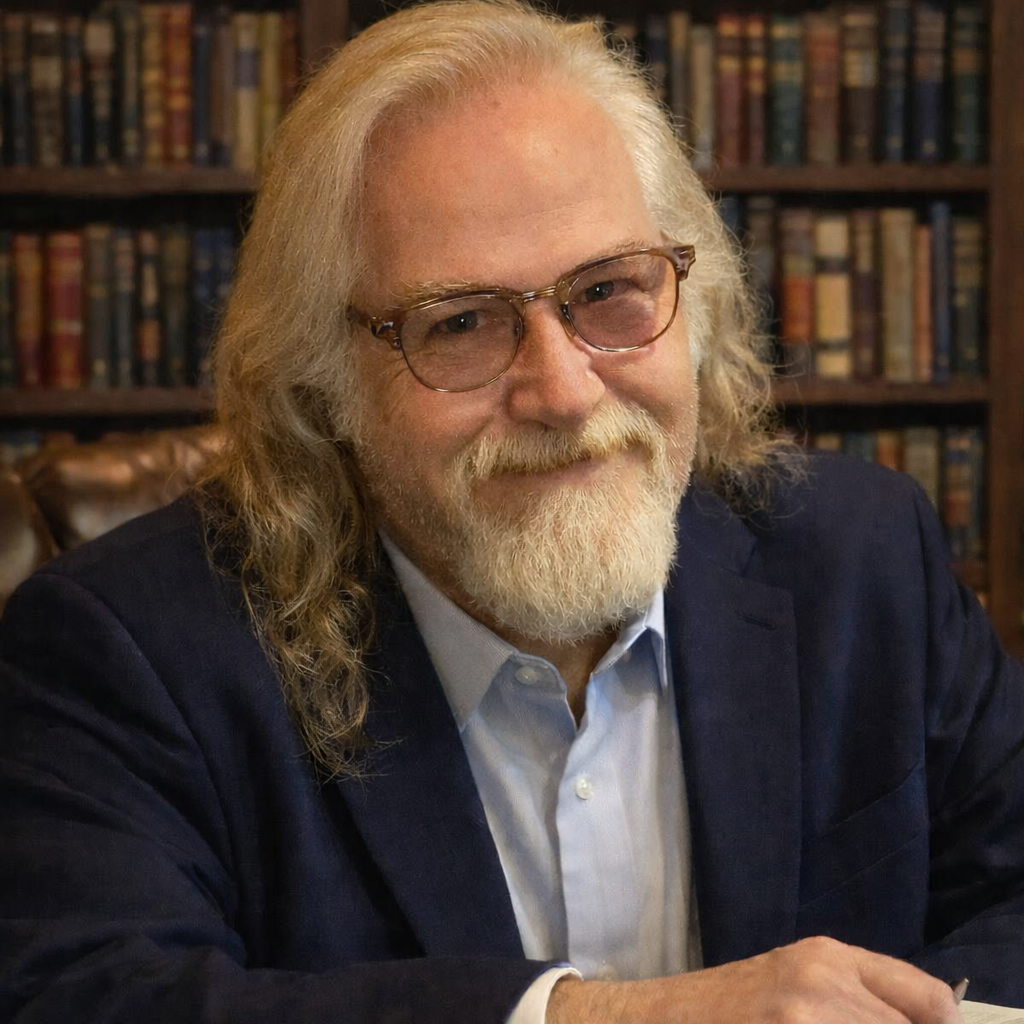
Gothic storyteller of haunted bloodlines and inherited memory.
C.C. Kell spent three decades in medicine before turning toward the written page, where anatomy and spirit meet in equal measure. A former Navy corpsman and sometime comedian, Kell writes of thresholds — between belief and doubt, body and soul, science and the supernatural.
His world, The Bavent Bloodline Chronicles,, explore how faith, perception, and legacy intertwine across centuries. Each story invites the reader not only to witness but to question: what if kindness, too, can haunt?
When not writing, C.C. Kell constructs digital spaces that breathe, letting readers walk the halls of his imagination — a living archive of light, shadow, and memory.
Interview: C.C. Kell on Legacy, Lineage, and the Eye
A sit-down conversation about where the stories begin, why a 17th-century nun still haunts the pages, and what comes next.
Interviewer: When did you first start writing?
C.C.: I’ve always been a storyteller. My first memory of actually writing was in the sixth grade. Someone at my school brought a magazine article about “The Legend of Boggy Creek,” a place in my home state of Arkansas. It was a short piece about what today we would probably call Bigfoot, living in the swamps of south Arkansas. I was fascinated. I wrote my own story about the monster that included my friends at the time. During a camping trip, we stumbled across the creature and had to survive its rage. I wish I still had that 15-page story. I remember my teacher got a hold of it and read it to the class. That was when I realized I could tell compelling stories.
Interviewer: So, you don’t have the story anymore?
C.C.: No. It was lost to time, but I still remember parts of it and how it felt to have my classmates appreciate being included in the story.
Interviewer: Did you follow the literary journey throughout your education years?
C.C.: Not really. I was never a good student in those days. Other things caught my attention, and I spent most of my time chasing girls and having fun with my friends. But I also love to read and while living in New Orleans in the late 1980’s I discovered Anne Rice. Needless to say, she became an influence on my writing. Books like Mexican Gothic by Silvia Moreno-Garcia have also shaped my style and the way I build atmosphere.
Interviewer: Looking back, do you regret not following that drive to write?
C.C.: Looking back, no. Even in the sixth grade, I realized that I could tell stories, but I didn’t think about writing them down until I was much older. At twelve, I didn’t have the life experience I do today. Since then I’ve seen and witnessed so much that, like most people, the stories in my head are often more comforting and enjoyable than everyday life. I have a pretty vivid imagination.
Interviewer: How did you use that ability to tell stories as you moved forward?
C.C.: I lived life. I joined the Navy after high school and my “frame of reference” changed. I grew up in a town of about 78,000 people in the South. We weren’t exposed to much of the wider world. Everything was new to me: education, religion, and culture alike. It was eye-opening. One way I fit into this new world was by telling stories about my childhood and small-town life. I always tried to find humor, and sometimes it went a little too far. I was quite the extrovert. If there was a silence in a conversation or gathering, I’d crack a joke or tell a story to get things moving again.
Interviewer: Did you ever do anything with your joke telling?
C.C.: Yes. I was trained to work in surgery while in the Navy. Orthopedics was my field, and I moved quickly in the industry after my discharge. I worked in hospitals in San Diego and Arkansas. I became an Orthopedic Physician Assistant and traveled the country from California to Texas and Arkansas over almost twenty years. I left the hands-on blood and guts and became an orthopedic implant salesman. While living in New Orleans, I joked that I got sick of sick people and took a different route. I went into radio as a salesman and on-air personality, using my humor and character voices, which led to a two-year stint as a stand-up comedian. After a few years of traveling and performing, I wanted stability again. I moved back to San Diego and to the operating room, still performing in comedy clubs on the side. I eventually returned to medical sales in Southern California and started hanging out with screenwriters in Camarillo. They introduced me to a writing format I enjoyed. We met weekly to work on projects and ideas. That became the catalyst for my current writing.
Interviewer: Is that where Legacy of the Eye began?
C.C.: Exactly. It started out as a screenplay. In 2007 it had a different name, Legacy of the Witch. The spark came from Aldous Huxley’s The Devils of Loudun. I was fascinated by the witch trials in 17th-century France. In my research I found the story of a young nun named Madeleine Bavent, living in Louviers and accused of witchcraft a few years after the Loudun trials ended. There isn’t a lot about her in the record, but enough to pique my interest. I’ve been studying the French witch trials ever since.
Interviewer: What made you so interested in her story?
C.C.: It wasn’t finished, or at least not in the official record. She was an orphan who entered the convent at eighteen and worked as a seamstress. After some time, she began exhibiting odd behavior. The elder nuns and the priests thought she was possessed, as with the nuns from Loudun. More young nuns began showing the same behavior. This drew the attention of the Church, and exorcisms were performed publicly, for the whole town to witness. Bodies contorted; foul language poured from Sisters of the cloth. A trial followed to find the cause of the outbreak. The priests were accused of secret rituals and rites that called upon Satan. One priest, Mathurin Picard, had died just as the trials began. By the end, another priest, Thomas Boulle, was convicted of blasphemy and heresy and sentenced to the stake. The accusations were so severe that Picard’s body was exhumed and burned alongside Boulle. As for Madeleine Bavent: her sentence was life in prison. She was sent to the dungeon beneath the convent to spend the rest of her life. There is no further certain mention of her in the record. Some speculate she died in the dungeon years later. Some rumors say she was impregnated by Picard. By then, my mind was racing with the thought every author has: “What if?” With my imagination, the story of the Eye was born.
Interviewer: Has Legacy of the Eye been published?
C.C.: Yes. It is available now on Amazon, my website and through bookstores.
Interviewer: What comes next for Legacy of the Eye?
C.C.: I’ve always envisioned the Bavent bloodline story as at least a saga. Maybe 4 books to start. The first book, Legacy of the Eye, focuses on Maddie Bennett, the modern-day heir to the Eye. It follows her acceptance of the inheritance and how she and her friends face the choices she must make. It ends quite climactically. The second book, which becomes available on March 1, 2026, Birth of the Eye, begins in 1602 France with my take on how the Eye was created, and follows how Madeleine Bavent came to claim it, or how it claimed her. It is written as a memoir, by Madeleine. The reader grows up with her and goes through the same journey she took. We travel with her and see the world through her eyes. The submission, betrayal and sacrifices she makes are only the beginning of what will follow. The third book, Inheritance of the Eye, follows the bloodline from arrival in America to the moment just before Maddie Bennett inherits the Eye. The fourth and final book, will pick back up after the first, Reckoning of the Eye, completes the saga with a modern-day push to reconcile the past and bring everything together for a dramatic ending. Each book stands alone, but together they build a Bavent Bloodline Chronicles. Through my website, I share glimpses of the bloodline and my vision.
Interviewer: It all sounds intriguing. I can’t wait to read all four when they come out. Thank you for sharing this with us.